Thursday, February 14, 2013

Sound Clips

One problem with the photographic big year is that many species look very similar and may not be identifiable by photo or range alone. Many times, hearing the bird is very helpful for field identifications. On 1/29/2013, while birding Lucky Hammock in Florida, we heard, and then saw, the Brown-crested Flycatcher that has been around most of the winter. While I took a reasonable photograph, Great-crested Flycatchers have been reported from the area as well. Instead of relying on some subtle field marks seen in the photo below, I have uploaded a sound file of the classic "whip" call of the Brown-crested Flycatcher that was calling while I photographed it. Turn your sound wayyyyyyy up, the file is quiet.

Brown-crested Flycatcher


I also photographed a Least Flycatcher at Paynes Prairie Preserve in Gainesville. Empidonax are notoriously tough identifications without a call or song. Luckily, this bird was giving the "pit" call typical of Least Flycatcher, and the accompanying field marks add up. Any other empid would be very rare here.

Least Flycatcher


I hope this works, as I plan to use this technique to nail down other tricky field identifications such as Fish Crow and other empidonax flycatchers, among others.

Tall Timbers and a Weekend Voyage

I've been working at Tall Timbers Research Station for almost two weeks and am loving it! The birds are great, weather has been alright, and the people are nice. But lets get right down to it: the birds. A couple of my favorite pictures this year have been taken on the property while out working. Both Grasshopper and Henslow's Sparrows winter here. Henslow's has always been notoriously hard for me to get even a decent look at, nevermind a photograph. I found these birds can be quite tame on their wintering grounds if you approach with care. Grasshoppers seem to pop out into the open while Henslow's will mouse around the understory vegetation. I really enjoyed watching a Henslow's feed right by my feet, at times too close for the camera to focus!

Henslow's Sparrow

Grasshopper Sparrow


What kind of work am I doing at Tall Timbers you ask? I'm nest searching for and banding Brown-headed Nuthatches. They are already excavating cavities in snags to be used as nests and are actively guarding them from Bluebirds and other cavity nesters.

Brown-headed Nuthatch
I'll walk you through some of the other commonly seen birds on Tall Timbers property. Red-headed Woodpeckers are downright abundant. Who could ever get sick of this flashy woodpecker?

Red-headed Woodpecker


Orange-crowned Warblers winter here and are seen daily.

Orange-crowned Warbler


It seems like you can't stop anywhere on our nuthatch plots without hearing an Eastern Towhee. They are thick in these woods and aren't too shy!

Eastern Towhee


On my first weekend (Feb 9 & 10), I picked up my friend Craig Bateman in Gainesville and drove to the South Skyway Fishing Pier where the Black-legged Kittiwakes had been seen. We didn't really know where to go, ended up walking around aimlessly for a bit, walked under a bridge and bumped into a feeding Razorbill!

Razorbill

We figured out where the actual fishing pier was, and on our way back to our car we saw some birders fixed on a floating gull. There sat a dying Black-legged Kittiwake. It appeared as though it would only last a few more hours, and that stretching it. No one saw it the next day.

Black-legged Kittiwake... not looking so well

We spent the night at Craig's place in Gainesville and birded Paynes Prairie Preserve in the morning. It was pretty quiet, but we found an obliging Ash-throated Flycatcher. Myiarchus flycatchers can be difficult to identify, but this one fits the profile of Ash-throated nicely. Smallish bill, drab underparts, rufous tail... and it was calling.

Ash-throated Flycatcher

There are some other, poor quality photos of common birds in the flickr gallery, so if you are bored feel free to check it out. I have a few more pictures that will be accompanied by an iPhone voice recording (Least Flycatcher and Brown-crested Flycatcher) if I can figure out how to upload them here. I have pictures of Fish Crow but my voice recording seems to have been deleted, so I'll work on getting another picture and recording soon.

I'm heading down to STA-5 near Clewiston, FL tomorrow (2/15) after work. The gates open at 830am on Saturday. The seven hour one-way trip is going to be rough, but the birding will make up for it. Purple Swamphen, here I come!

 I'll also take this time to remind you of the pledge page here. The birds of Hawaii would really appreciate it!

Tuesday, February 12, 2013

The End of the Trip

The last two days of our epic Florida trip (2/1 and 2/2) were used to add to the year list and nail down some lifers. On 2/1 we birded around Fort De Soto. A Great Horned Owl has built a nest low in a pine and was a crowd pleaser.

Great Horned Owl

We had a nice selection of shorebirds but most were far out due to tide conditions. Still, we managed to find a Marbled Godwit and a couple American Oystercatchers. They were too far for photographs, although I have a few Oystercatcher photos on my phone I may upload later.

On our way out of the park, we scored some Nanday Parakeets, recent additions to the ABA checklist. The picture isn’t great as they were along a busy road and stopping for more than a few minutes could have been detrimental.

Nanday Parakeet

We drove over to Edward Medard Park where Snail Kites recently bred. No Snail Kites could be found, but near the parking area we had Blue-headed and White-eyed Vireo.
 
Blue-headed Vireo
White-eyed Vireo
Our final stop before heading toward Tallahassee was near Hernando Beach. This spot contains most of, if not all of the remaining “countable” Budgerigar population. I fully realize this species may soon be subtracted from the ABA List, but we were close enough that it would be silly not to try. We found 8 birds sitting communally in a homeowners front yard.

Budgerigar

On 2/2 we birded St. Marks NWR hoping for more ducks and perhaps a Snow Goose. It was here we had our first Carolina Chickadees of the trip. They were singing away, a much different song than Black-capped. Also, the Black-capped Chickadee range doesn’t extend at all into Florida, to help avoid confusion.

Carolina Chickadee

Northern Harriers were busy hunting the marshes. This one landed and made some harsh calls, frightening the poor coots nearby.
Northern Harrier

There were large blackbird flocks around the refuge, but we failed to find any Rusty Blackbirds that had been reported. Red-winged Blackbirds were singing, though.
Red-winged Blackbird

We found a loaded duck flock containing a few new species for the trip. American Wigeon, Canvasback and Northern Shoveler all winter at the refuge.
American Wigeon and Northern Shoveler (with Redhead)

Canvasback

It was time to drop my dad off at the Tallahassee Airport, thus ending another epic adventure. While I didn’t have to move in for a while yet, I ventured over to a private residence allowing birders to view their female Broad-billed Hummingbird. Not too long after I arrived, the bird made an appearance.
Broad-billed Hummingbird

After such a long, successful birding trip with my dad (170+ species!), it was nice to move into my new home at Tall Timbers Research Station and relax. I’ll soon be caught up with all my birding photos from this year. There is still so much to post about! Keep checking back.

Sunday, February 10, 2013

Ding Darling, Sanibel and Beyond

On 1/31/2013 morning we birded at Sanibel and Ding Darling NWR. We started at the lighthouse in Sanibel and quickly found 3 Razorbill! I took a possibly, maybe, barely identifiable photo of one that I was going to post. Fortunately, yesterday Craig Bateman and I found a/the Skyway Fishing Pier Razorbill that I got much better photos of, but more on that later.

We worked down the beach and found many terns, gulls and skimmers loafing on the beach. Black Skimmers are awesome!

Black Skimmer

Ding Darling was full of wading birds. Immediately after paying our entrance fee, we noticed this Yellow-crowned Night-Heron attracting a crowd.

Yellow-crowned Night-Heron

A little further up, a few birds were sitting or fishing in some shallow water near a culvert. Roseate Spoonbill, Reddish Egret and American White Pelicans were in wonderful light.

Roseate Spoonbill
Reddish Egret
American White Pelican

Along the drive, Common Ground-Doves were scattered about. In my experience, these are quite a skittish dove. Using the car as a blind, I was able to get a useable photograph.

Common Ground-Dove

After completing the wildlife drive, we headed to Cape Coral. We followed up on a recent report of Burrowing Owls at the Pelican Blvd. Baseball Fields. Sure enough, a few Burrowing Owl mounds were roped off. Most must have been sleeping since they were not very obvious. Only one owl was poking his head up from underground.

Burrowing Owl

Florida Scrub-Jay was another target. We checked a few spots; Shamrock Park and Caspersen Beach just south of Venice with no luck. We finally moved to Oscar Scherer State Park, a well-known spot for the Jays. With a tip from another birder, we found a couple of friendly Jays who were curious to our presence.

Florida Scrub-Jay

We had a bit of time to check a few beaches further north, but we found nothing too exciting. We called it a night and prepared for our next day of birding. My next post will include photos and commentary from Fort De Soto, St. Petersburg, and Hernando Beach!

I’m almost caught up with postings from our birding trip down here. I have a ton of pictures from birding around Tall Timbers and my first weekend off. Hopefully I’ll be all caught up soon!

Thursday, February 7, 2013

The West Side of Florida

On 1/30, we woke up in Homestead. Our goal was to make it to the west side of the state, birding the Tamiami Trail on the way, and hitting some beaches once we got there. But not without driving around Homestead to find a  Common Myna. It took all of 5 minutes to find a line of birds strung up on a wire preening in a Starling like fashion.

Common Myna

We started birding our way west along the Tamiami Trail. Last year, I photographed a very cooperative Purple Gallinule at the "Everglades Safari Park", so we stopped here to see if the bird might still be around. Sure enough, we found the bird foraging on the lawn with White Ibis and Boat-tailed Grackles. Too easy. It was too tame and I had to back away to fit the bird in my 300mm lens!

Purple Gallinule

We eventually made it to the west coast of Florida, managing to miss Short-tailed Hawk in areas where they have recently been seen. A real tragedy. Our first stop on the gulf side was Tigertail Beach on Marco Island. The beach was full of shorebirds including hoards of Dunlin, Western Sandpipers, Plovers, Dowitchers and Knots. A few other birders were enjoying the birds as well, until a little boy decided it was a good idea to run at the flocks and scare them off the beach; his mom watching the whole thing. At least I got my shots off before this event took place. Mind you these aren't great shots as the sun was high overhead, but not much I could do about that.

Wilson's Plover

A banded Red Knot

Black-bellied Plover (better pics to come)

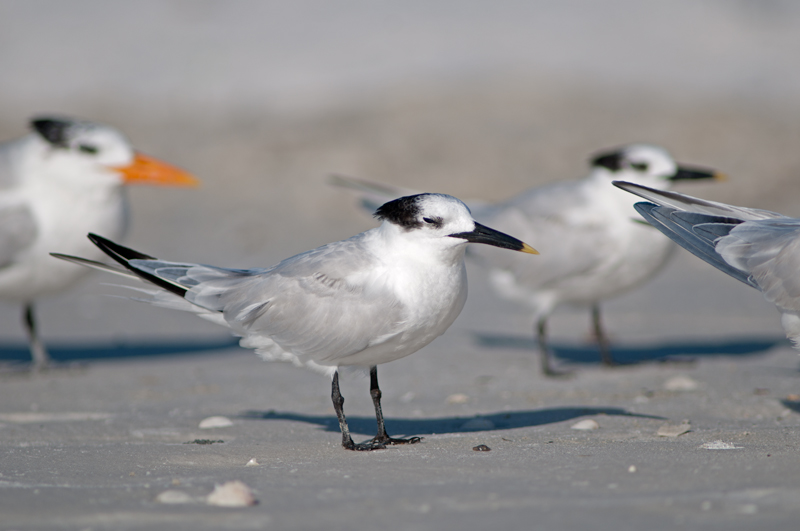
We moved north to Fort Myers beach. Thus far we missed Snowy Plover at every stop. Again, we failed to find one here. We did have a few roosting gulls and terns on the beach, and here is where I got some good Sandwich and Royal Tern photos.

Sandwich Tern

Royal Tern

More pictures from the Everglades that I didn't get around to editing earlier, and more shorebird pictures can be found on the flickr website. The next post will include photos from Sanibel, Ding Darling NWR and a few other spots. Many more photos to come! And please check out the donate page, if you haven't already, to find out how you can help bird conservation! Big thanks to all those who have already shown their support!

Tuesday, February 5, 2013

Everglades Birding

Day 4 of our trip (1/29) took us to the Florida Everglades. We spent an entire day in and around the Everglades, beginning with Lucky Hammock. At first light, we had a very distant Barn Owl come in to roost. Given the extreme distant, I was surprised I got an identifiable photo. It isn't one I'm proud of... but I'll count it until I can do better. We found many good birds here, including the previously reported Brown-crested, Great-crested and Ash-throated Flycatchers.

Horrible photo of a Barn Owl

Once into the 'glades, we made a few stops along the road to Long Pine Key. The roadsides were littered with Yellow-rumped Warblers. I've never seen so many in one place in my life! A little "pishing" attracted gobs.

Yellow-rumped Warbler
Palm Warbler was another very common sight. We found these at almost every stop we made.

Palm Warbler
Long Pine Key is host to some special butterflies, but we didn't find any. I will have to go back later in the season to look for them. It did provide me with my first Red-shouldered Hawk photographs.

Red-shouldered Hawk
Snake Bight trail contained very few mosquitoes, a very rare sight. We took full advantage and walked the trail to the boardwalk. No Flamingos were found, but plenty of good landbirding along the way. The more common warblers were conspicuous, including Black-and-white Warbler and American Redstart.

Black-and-white Warbler

American Redstart hiding
We finished the day in Flamingo at the terminus of the Everglades. We found no blackbird flocks and no Ani. We planted ourselves along the Coastal Prairie Trail at dark calling for Black Rail, which was also a failure. I suppose pre-dawn would have been better.

These aren't the only pictures from the day, more (including Vermilion Flycatcher and more warblers!) can be found here.

We ended in Homestead for a good sleep before heading across the Tamiami Trail to bird the western part of the state. Those pics will be up soon.

Just a reminder, one of the goals of this photographic big year is to raise money for American Bird Conservancy's work with endangered Hawiian bird species. Please consider pledging to help this great effort! All pledges go directly to the ABC. See this page for more information. It's easy!

Sunday, February 3, 2013

Miami Rarities and Exotics

Day 3 of our Florida trip took us to Miami to track down some of the recent rarities and exotics. Our first stop was Virginia Key to look for the female Western Spindalis. There was a negative report from the day before, and it seems the bird moves around a lot, so we figured on spending a while looking. Luckily, local birder guru Robin Diaz was helping another birder look for the bird. We all scoured the area until Robin and I caught a glimpse of the bird flying in and calling. Unfortunately, it flew out of the area before anyone else saw it. A while later, my dad found the bird but still, we only had brief, distant looks. This bird was not cooperative! Finally, after a while longer, my dad spotted the bird, mostly obscured by leaves, silently feeding on opossum berries. How he spotted this thing, I will never know. I managed only one identifiable photo, but it should do the trick.

Female Western Spindalis

On our way back to the car, we spotted a few Crescents (butterflies). Robin told us she had some Cuban Crescents here recently. Sure enough, that is what these were. I hear they haven't been seen in Florida for many years! We failed to find any Short-tailed Hawks that had been reported.

Our next stop was Crandon Beach, a hotspot for wintering shorebirds. We were not disappointed. Hoards of Sanderling, Dunlin, Piping Plovers and Semipalmated Plovers were resting on the beach. Most of the beach birds in Florida have no fear of humans and are easily approachable.

Semipalmated Plover

Piping Plover

Sanderling

Dunlin

We then made our way to Kendall for exotics. We found Monk Parakeets across the street from the Kendall Hospital. They were loud and conspicuous as ever.

Monk Parakeet

Red-whiskered Bulbul and Spot-breasted Oriole were major targets as well, but we didn't have much luck with these. We drove Kendall and Kendallwood neighborhoods. In Kendallwood, we finally heard two Bulbuls calling back and forth in the front yard of a house, but I never got a look at them. No Orioles were seen.

Finally, we drove back up to Miami and hung around the North Shore Medical Facility, a known area where White-winged Parakeets roost. We drove some back roads and heard some distant parakeets flying over. We finally spotted a group of noisy parakeets dropping down into some Royal Palms to roost for the night. I could have managed better pictures, but this area is a place you probably don't want to leave your car...

White-winged Parakeet

White-winged Parakeet
We finished by battling the horrific Miami traffic down to Homestead where we spent the night.